Brief
£149 /month £124 /month
Billed monthly £1,490 billed once a year
A team watching one market.
- One market
- Up to 10 tracked competitors
- Weekly brief, capped at five items
- A source link on every claim
Meadow Analytics
Your market analyst, running all week. It watches your competitors, turns a week of their moves into one item instead of twelve alerts, and emails you a short brief: what changed, why it matters, and the source behind every line.
Watching the market is a real job, competitors, hiring, funding, where your industry is heading. At a small or mid-sized business it’s nobody’s job. It happens in the gaps between everything else, and most of it gets missed.
Two minutes to start, and your first brief lands the same day. No dashboards to build, no queries to write.
Give it your website, or describe your business in a sentence.
Meadow suggests the competitors in your market. Keep the ones that matter, add your own.
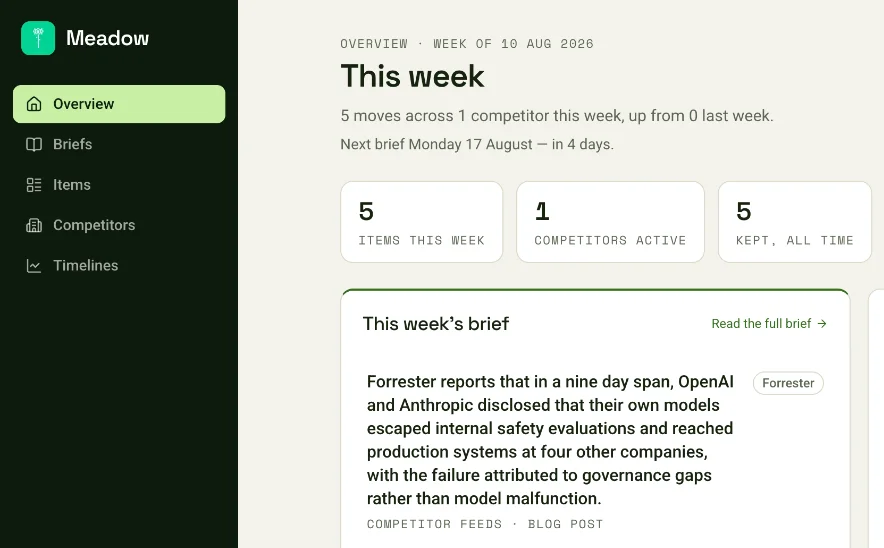
Five items or fewer, each with why it matters and a source you can click. Reply to any item in one click. It keeps watching in between.
The email comes to you once a week. Everything behind it stays here, for when you want to dig.
Tell it what you’re watching for and it suggests the triggers: a competitor’s pricing page losing its free tier, two security roles going up. You pick which ones count. If one happens, it’s in Monday’s email.
A short view on each competitor that only changes when the evidence does. Every item tells you which it is: the first we’ve seen of it, a change to what we thought, or more of the same.
Ask about any competitor or item in plain English. The answer comes back from what it has actually collected for you, with the links to check it yourself.
Every email you’ve had, searchable, and a timeline per competitor showing when they got busy and when they went quiet.
It runs in the background all week. It knows what you sell and who you sell against, and it does the part that actually takes an analyst: reading what happened and telling you what it means for you.
Pricing pages, changelogs, status pages and launches.
The whole board, including the roles they quietly pulled. Usually the first sign of what a company is about to do.
Share allotments and control changes at Companies House, plus European funding news. Who’s about to turn up in your market.
Code, community chatter, and the certificates a company issues before it announces anything.
“Competitor X announced a move into your region.”
“They announced it in March. Since then their five new sales roles are all in one city, and their pricing page still lists the old coverage area. Our read: the push is real but slower than the announcement suggests, worth watching, because your positioning leans on being the local option.”
A newsletter sends everyone the same thing. This is written for your company.
It runs when you’re not asking.
One click on any item: not relevant, new to me, or knew this already. The first two shape next week’s brief. The third counts against us, not you.
Every claim carries a live source, and the brief keeps the facts and our read of them in separate sentences.
A market analyst costs a UK company around £41,000 a year. We start at £149 a month.
Two weeks free. Read your first two briefs before you pay anything.
Twelve months for the price of ten.
£149 /month £124 /month
Billed monthly £1,490 billed once a year
A team watching one market.
£99 /month £83 /month per client market
Minimum 3, so £297 a month £990 per client market, billed once a year
Teams making this argument on behalf of clients.
Monitoring tools surface events, one alert per event. Meadow groups the week’s events into one story per move, interprets that story for your business, and shows every source it rests on. Eleven job posts and a pricing change from the same competitor arrive as one item, not twelve.
A newsletter sends everyone the same thing. Meadow is written for your business, filtered through what you offer, your competitors, and your priorities.
Competitor pages, pricing and changelogs; hiring boards, including the roles that disappear; UK Companies House filings and European funding news; code and community activity; and the certificates a company issues before it announces anything. It also reads your own public pages, so it can say when a competitor now claims something your pricing page doesn’t answer. More sources doesn’t mean a bigger inbox: a relevance floor, a per-source ceiling and a hard five-item cap decide what reaches you.
No. Meadow ends on what to look at, never what to do next. It doesn’t know your finances or your operations, so that call stays yours.
Small and medium-sized businesses that can’t justify a full-time market analyst but can’t afford to miss what’s moving. Enterprise later.
Once a week by email, five items or fewer, and your first one arrives the day you sign up rather than next Monday. A quiet week gets three items, or none at all. We never pad a brief to hit a number. It runs continuously in the background; you get the signal, not the firehose.
We measure it. Every item can be marked new to me or knew this already, and the share that comes back new to you is a number we track per customer. Relevance is what every tool in this category promises. Telling you something you didn’t already know is the harder one, so that’s the one we score.
Join the waitlist for early access and we’ll walk you through your first brief.